

| Decision | Supported figure or rule | Planning use |
|---|---|---|
| Main walkways | At least 90 cm wide | Treat this as a floor-plan minimum and place the sofa and shelving around it, not the other way round. |
| Sofa to coffee table | 40–45 cm between them | Pick a coffee table small enough to keep this gap, or choose a lift-top model that does two jobs. |
| Chair depth | Under 30 inches deep if the room is under 12 feet wide | Filter armchairs by depth first, then by style. |
| Rug size | Large enough that at least the front legs of each seat sit on it | Size the rug to the seating group so the furniture reads as one zone. |
| Mirror position | Large mirror opposite or beside a window | Hang the biggest mirror where it catches daylight, not on the darkest wall. |
| Lighting | Several soft sources rather than one bright light | Add lamps in layers instead of upgrading a single ceiling fitting. |
Figures come from the small living room layout guide from Del-Dar and the small-apartment furniture guide from Payless Home Goods.
The best small apartment ideas start with measurements: keep walkways clear, choose shallow furniture, store vertically and let light and mirrors do the rest. Fit matters more than quantity, so check room size and delivery route before buying.
Window treatments belong in the same plan, so see how to choose curtains for a living room for the wider decor choices. Outdoor space is a separate job, covered in Small Apartment Patio Ideas: 12 Stylish Ways To Transform Tiny Outdoor Spaces In 2026 – Getoku.
Sizing furniture to the room
Room dimensions decide the seating plan before style does. Retailer guidance from Del-Dar links sofa configuration to room size, which gives a useful starting point for choosing between a sofa, a loveseat and extra chairs.
Match the seating plan to the room
- Room about 3.0 × 3.5 m: a three-seater against the longest wall, facing the TV, with one accent chair to the side. This suits a compact living room that also holds a TV unit.
- Room about 3.5 × 4.0 m: a three-seater and a two-seater in an L, or a three-seater with two accent chairs. The second option is often more flexible than a full sofa set, because chairs can be moved when the room has to do something else.
- Room about 4.0 × 5.0 m: a 3-2-1-1 sofa set in a U around a coffee table, with the open side facing the TV. Only a room of this size carries a full set without crowding.
Check depth, arms and legs
Depth matters more than width in a small room. According to Payless Home Goods, a 72 in × 38 in loveseat consumes more space than an 84 in × 32 in sofa, so the shorter piece is not automatically the smaller one. The same guide describes a compact two-seater with an 84 in × 35.5 in (213 cm × 90 cm) footprint, a useful reference when comparing listings.
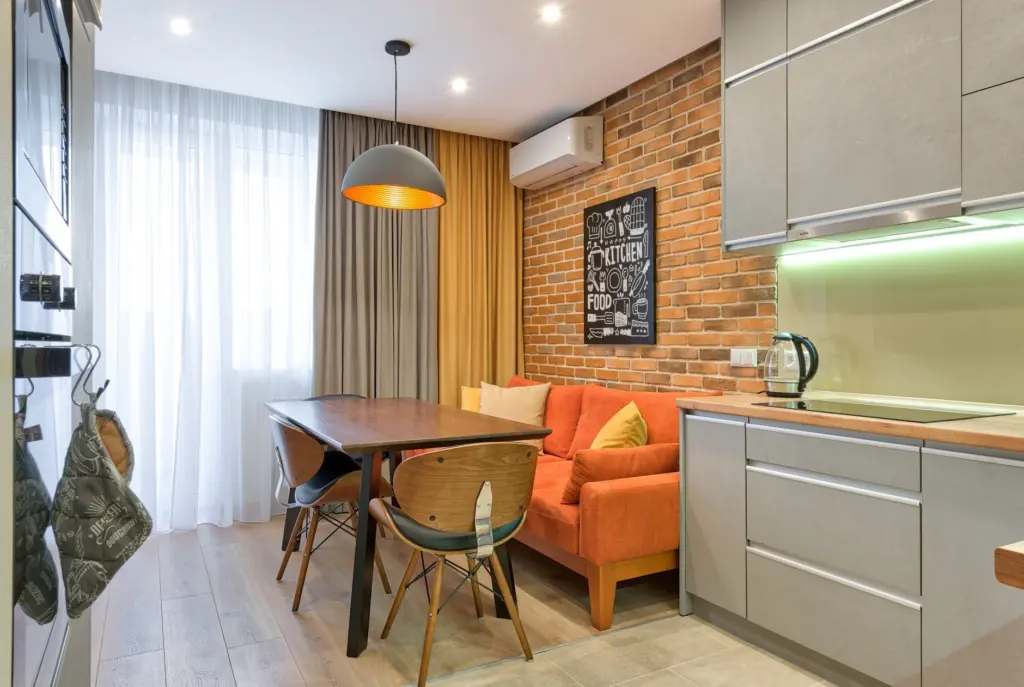
Arms and legs change the footprint too. Del-Dar warns that oversized arms can add 30 cm or more to a sofa’s width, and that sofas on visible legs show more floor, which makes a room feel larger. If you are choosing between two similar sofas, take the slimmer-armed one with visible legs.
Furniture that does double duty
Multifunction pieces give a small apartment more uses without more rooms. They suit people who host guests or work from home only occasionally and cannot dedicate floor space to either.
- Sofa bed: Payless Home Goods notes that a sofa bed turns a living room into a guest bedroom without requiring a second room. It is the logical choice when the apartment has no spare bedroom.
- Round extendable dining table: the same guide describes a round model of 43–59 in that expands to seat 6–8 people and includes hidden storage. It suits a flat where the dining table doubles as a desk or hosting table.
- Lift-top coffee table: it provides a functional surface and hidden storage in one footprint, which helps when you want a coffee table without another cabinet.
Storage without clutter
Storage stays calm when it uses height and hidden space, not extra floor-standing units. The aim is to reduce what is visible on surfaces while keeping everyday items within reach.
Go vertical first
Del-Dar says tall, narrow shelving draws the eye upwards and stores more without taking floor space. Where a cabinet would feel heavy, Payless Home Goods points out that floating shelves add storage without the visual weight of freestanding cabinets. Choose tall narrow shelving when you need volume, and floating shelves when the wall is short or the room is very tight.
Let shelving divide the room
In an open-plan apartment, a divider or open shelving unit separates living and dining zones without blocking light. This gives one piece two roles, storage and zoning, and keeps windows working for both areas.
Keep surfaces clear
A coffee table with a shelf or drawers for remotes, magazines and chargers keeps surfaces clear, according to Del-Dar. Give every small item a defined home near where it is used, and the surfaces stay visually quiet.

Light, mirrors and colour
Light and reflection change how big a room feels without changing its size. These choices cost little compared with new furniture, so make them after the layout is settled.
- Mirror placement: Del-Dar says a large decorative mirror opposite or beside a window reflects light and gives a sense of depth. A large mirror bounces light around the room and creates the illusion of depth, so it is worth giving it the best wall.
- Layered lighting: several soft sources make a room feel larger than one bright light. Use lamps at different heights and keep the overhead fitting as a supplement.
- Clear windows: avoid placing tall furniture in front of windows, and use light curtains, so daylight reaches the room.
- Calm tones: grey, beige and soft blue recede visually, while a dark, bulky sofa dominates a small room. If you love a dark colour, use it on small accessories, not on the largest piece.
- Rug size: anchor the seating with a rug large enough that at least the front legs of each seat sit on it, so the sofa and chairs read as one group.
Checking the delivery route
A piece that fits the room can still fail at the door. Del-Dar advises measuring the building entrance, lift, corridor and apartment door before ordering, because large sofas, sectionals and TV stands must fit through each one.
Payless Home Goods adds that standard elevators are 36 in × 48 in, adequate for tilted sofas but not sectionals. For a small apartment with a lift, that favours a standard sofa over a sectional. If any step on the route is tight, choose a smaller piece.
Frequently asked questions
Is one large mirror better than several?
Either can work. Besides the single large mirror beside a window, Architectural Digest says multiple mirrors of different sizes in a studio apartment are an effective way to expand the space.
What is a compact way to store shoes?
A rotating shoe cabinet can hold 24 pairs in a 56-inch footprint and lets you see every pair, according to Payless Home Goods.
Which fold-away pieces suit a studio?
Architectural Digest suggests pieces that fold away when not in use, such as Murphy beds and drop leaf tables, so the floor is free when they are put away.
Will a larger rug make a small room look smaller?
Not necessarily. Architectural Digest notes that a larger rug may actually make tight square footage appear roomier than a rug paired with smaller furnishings.